

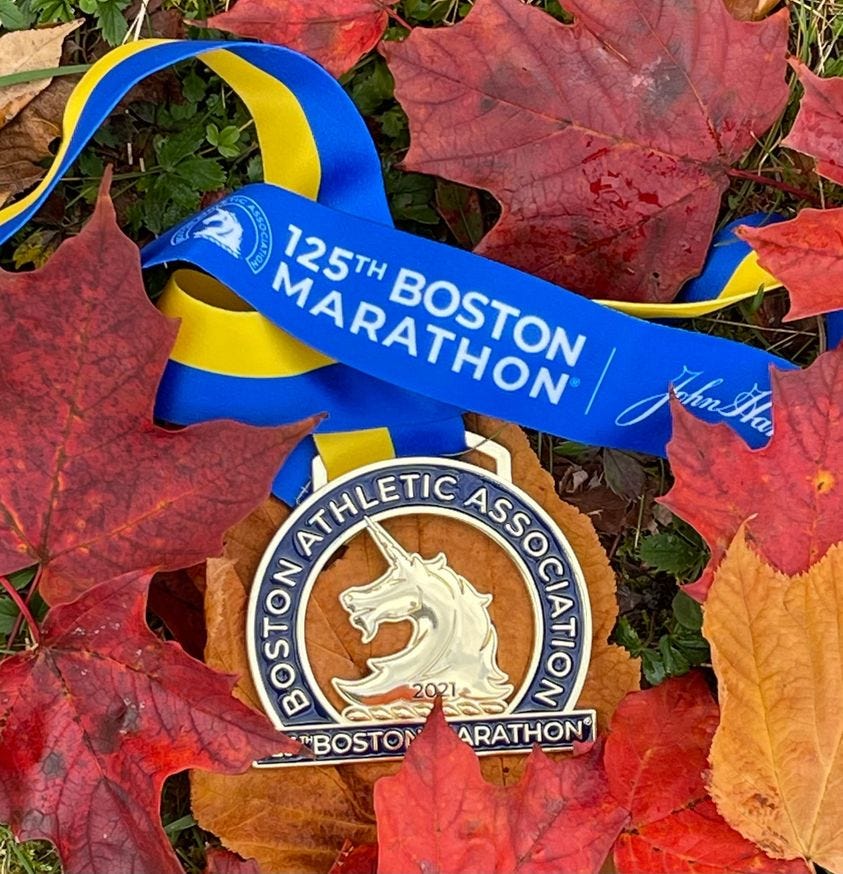
Today is the 130th Running of the Boston Marathon. Marathon Monday.
We live in a culture that praises endurance. Resilience. Strength. We don’t ask what we are enduring, or what it is costing us.
I subscribed to the endurance mindset for decades. Pushing myself to physical extremes, I was generally applauded for overriding my body’s limits. Running the Boston Marathon was a dream I worked toward for decades, overcoming so many injuries and setbacks to get there.
Accomplishing that dream was one of the best moments of my life. I imagined watching each Boston Marathon after with pride, reliving those moments with joy and a full heart. While I do feel joy thinking about the times I ran the Boston Marathon, those memories are also touched by grief. This is the thing about grief. It laces itself into everything, even joy. There is not a moment that it isn’t with me because there is not a moment that my daughter Maisa isn’t with me.
Distance running helped me for many years, in so many ways, and I am grateful for that part of my life. Many autistic people will share similar stories of how some kind of exercise helps them regulate. For me, the structure of marathon training, repetitive movement of running and bonding over shared interests with others provided structure and relief from a world that could otherwise feel chaotic and overwhelming.
In endurance sports we often talk about getting comfortable with the uncomfortable. Of course we are talking predominantly about learning to be with physical discomfort. Or more accurately, learning to push through it. I am not going to try to convince you that I was fully present in my body at mile 22 of any marathon. You won’t find many athletes congratulating themselves or each other for taking a DNF (did not finish) because they listened to their body. And yet, grief has required me to take a DNF on the life I used to lead. It has forced a stop that no one cheered for, proving that the hardest part is not the running, it is choosing to stop when your soul can no longer keep pace with the world.
What is the true lesson around endurance, resilience and strength? Is the strength in staying with what is hard, or in running from it?
I thought about this a lot during my marathoning years, as I hurled my body towards a finish line as fast as I could. Am I running to something or running away from it? And what exactly am I chasing? What might be chasing me?
I explored this question deeper through my yoga and meditation practices and eventually through a yoga teacher certification. Running felt natural to me. The endorphins that come with it are exhilarating. Sitting quietly and tuning in is harder. Being with yourself can be messy. And yet, it is a necessary part of being human.
Grief has been the biggest teacher of all. It is the ultimate endurance event I did not know I was training for. The one with no training plan, no coach, no team camaraderie, and no finish line. Grief has taught me how few in our modern society can actually stay with uncomfortable emotions. And yet, we need witnesses. One of our deepest desires as humans is to be seen. We are not incapable as humans of feeling deeply, but we have lost touch with these practices. We seem to have walled off our heart muscles as a collective and let them atrophy.
We praise endurance that disconnects us from ourselves, and we call that strength.
Feeling, in practice, is going to look different for everyone. Learning how to do this has been as hard for me as any marathon training plan, and with less external feedback or praise. There is no Garmin watch telling me that my training is “Productive.” No spectators with witty posters. No finish line. In fact, embracing this emotional training has come with losing just about everything our society might call “success.”
But somewhere along the way, in peeling back all the layers, I learned, and continue to learn, something important. Just like staying with physical discomfort, staying with emotional discomfort teaches us a lot about ourselves, humanity, and the universe. We learn about our patterns, our fears, our desires. We see our power, our place, and who we truly are underneath all of the layers of societal conditioning. Staying with emotional discomfort is the doorway to connection - with ourselves and with each other. If we run from it, we remain unknown.
All those years I spent running in pursuit of external goals, enchanted by the siren song of the spectating crowd, I could not hear the quiet whispers of my soul.
When we spend all of our time running toward who we think we are supposed to be, we miss out on who we actually are.
This piece reaches somewhere very true and very needed. The passage about how few people can truly sit with grief strikes at the very core of our modern wound. We live in a world that celebrates performance, speed, distraction, and endurance, yet often turns away from sorrow, vulnerability, and the sacred work of witnessing one another. Your words about needing witnesses name something essential: healing so often begins not in fixing, but in being seen. And the line about our heart muscles atrophying as a collective is especially powerful—it captures how emotional numbness has become normalized, even rewarded. This is such an honest and necessary reflection on what real strength may actually be.
As always eloquently written and deeply felt. As you said our society is based on ignoring and normalizing pain and hiding struggles. Living in the reality of grief and emotion is seen as a negative, sometimes weakness. Sitting in the reality of loss and grief is hard for people seeing it often because they can’t acknowledge it for themselves. Your writing and teachings us about the hard parts of life brings a light to all who know you and read your hard earned wisdom. Thank you, Samia