

Throughout my childhood, the rules were unspoken but crystal clear: hide the autistic traits that make others uncomfortable, and perform the ones that make the adults around you look good. Being autistic and intellectually “gifted” is acceptable to the outside world, right up until your special interest crosses an arbitrary line, demands extra resources, or makes a classroom inconvenient.
Be smart, but not too smart. “Normal” smart. The kind of smart that reflects well on a standardized test or makes adults feel impressed. Not the kind that asks the adults in the room to look deeper, adjust their curriculum, or do more work. Don’t make things weird. Don’t make things difficult.
In first grade, my teacher encouraged reading with stickers. Six-year-old Samia loved both reading and stickers, so this was very exciting. Every time I finished a book, I got a new, shiny sticker. But somewhere along the way, the reward stopped. My teacher told me to stop. I was reading too much. I was too much.
Did anyone pause to ask why a six-year-old girl who struggled painfully to connect with her peers spent every waking minute buried in books instead of people? Of course not. Books didn’t demand eye contact. Books didn’t punish me for missing social cues. In fact, they helped me understand the confusing world around me. And most importantly, a child reading silently in a corner isn’t bothering anyone.
Thirty-three years later, I watched my daughter, Maisa, live the exact same script.
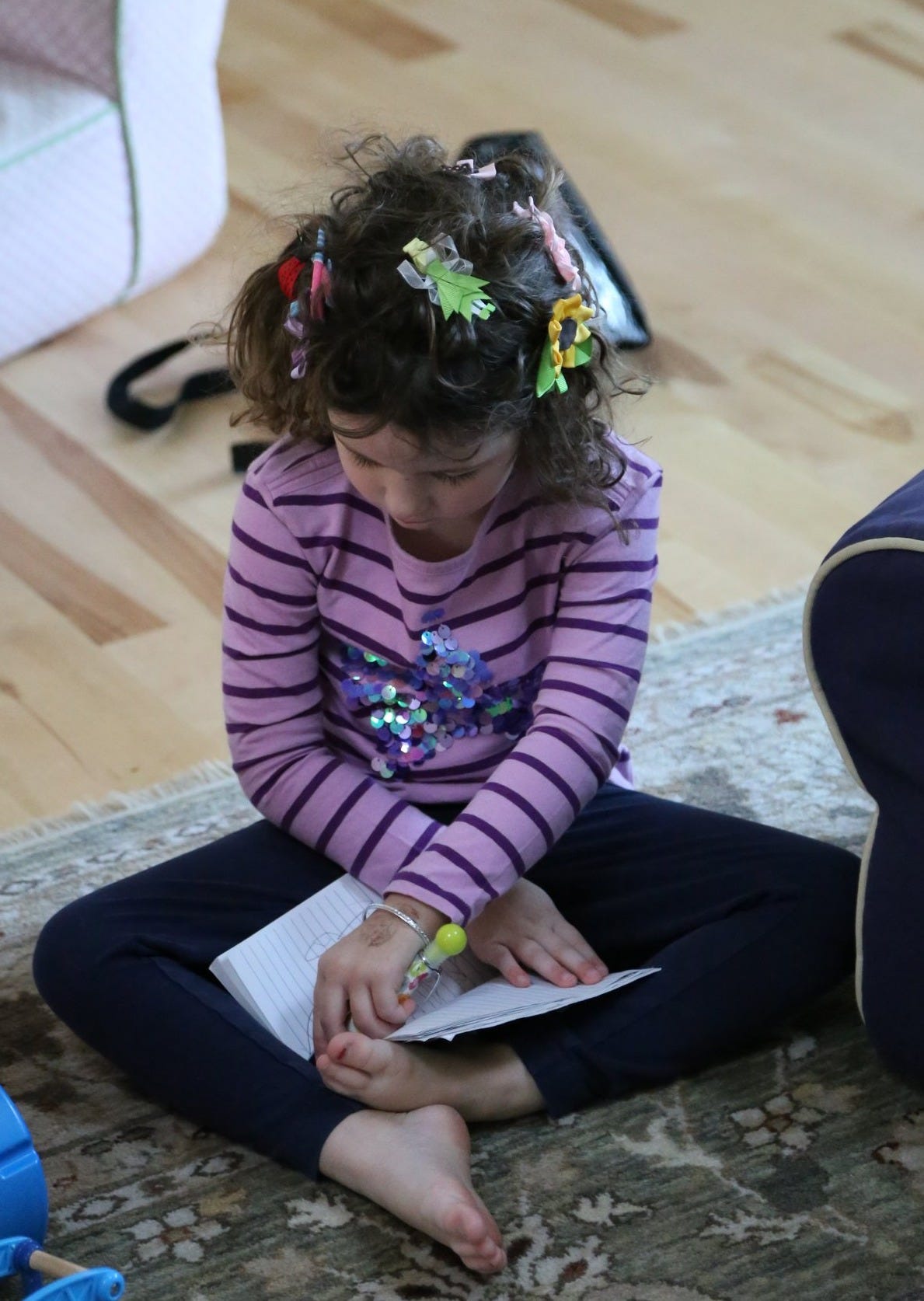
She read early and voraciously, devouring books faster than we could buy them or borrow them from the library. She spoke in complex, grown-up sentences while quietly drowning in the social world of her peers. Recess was the hardest part of her day. So she started bringing a favorite book to school and sitting alone with it while the other kids played.
Same corner. Same sanctuary. A generation apart.
What we were living has a name: hyperlexia. It’s a self-taught, advanced ability to decode words far beyond expected milestones, often paired with an intense fascination with text. In autistic children, it isn’t simply an academic head start. The ability to read words races ahead of the ability to process language, conversation, and social nuance. A child showing signs of hyperlexia likely needs specialized support, not a gold star.
Hyperlexia is often missed as an early sign of autism precisely because it gets called giftedness. As long as the child performs well academically, most adults don’t look further. They didn’t for me, and they didn’t for Maisa.
I asked for help again and again. But Maisa wasn’t a “problem.” Her grades were good. She was “gifted.” My pleas were met with a polite, institutional shrug, and the same story adults had told about me decades earlier: “She’s fine. She’s advanced. We don’t see any real issue here.”
They saw a quiet girl with an impressive vocabulary, reading alone at recess, and called it a love of books. They didn’t see what happened after the final bell: Maisa coming through our front door and collapsing, needing hours alone in her room just to recover from the school day. They saw a child holding it together. I saw what it cost her.
If a child isn’t disrupting the classroom, she doesn’t exist as a child who needs help.
This happened over and over. Until she wasn’t fine at all.
When schools measure neurodivergent children by grades and compliance, they mistake performance for well-being. Autism is a disability. A child’s struggle being quiet, showing up in playground exclusion instead of on a report card, doesn’t make her support needs disappear. When a school ignores a child’s distress year after year until she breaks, it adds layers of trauma that were entirely preventable. That harm doesn’t come from being autistic. It comes from being overlooked.
Maisa and I were both hyperlexic. We could decipher complex text years before our peers while struggling to navigate the unspoken rules of a world not built for us. Our reading was never proof that we were thriving. It was a sanctuary we built to survive places that overwhelmed us.
Autistic children deserve to be identified and supported early, in body and mind, not after years of silent masking and not after burnout has broken us. Hyperlexia isn’t a gold star to celebrate and dismiss. It’s a signal asking us to lean in and look closer. If we want to spare the next generation, we have to stop measuring children by how convenient they are to manage, and start believing them and their parents before they reach a point of crisis.
Thank you for this. ♥️ I think this is how my own autism showed up. Thankfully when my now 6-year old started showing signs of hyperlexia (even more hypernumeracy), I immediately came across the autism link when looking online. It was a shock at first because I’m a mental health professional and he didn’t show any of the signs I’d been taught to look for with autism. I’ve had to advocate so hard for him and I worry so much about how things will progress as he gets older. He’s in kindergarten now and special ed is already saying how great he’s doing. I worry that will translate into them taking away the supports we’ve fought so hard for. Thank you again for this important article 💗
The part about being “too much” when simply reading and receiving a sticker, is where institutions operate from. This piece of writing truly spoke to me, and I find myself nodding and shaking my head in every section. Nodding at the need for specialist support, and shaking my head when children are brushed off with a gold star and an unregulated nervous system. Thank you for sharing this, your voice is truly powerful and so so needed.